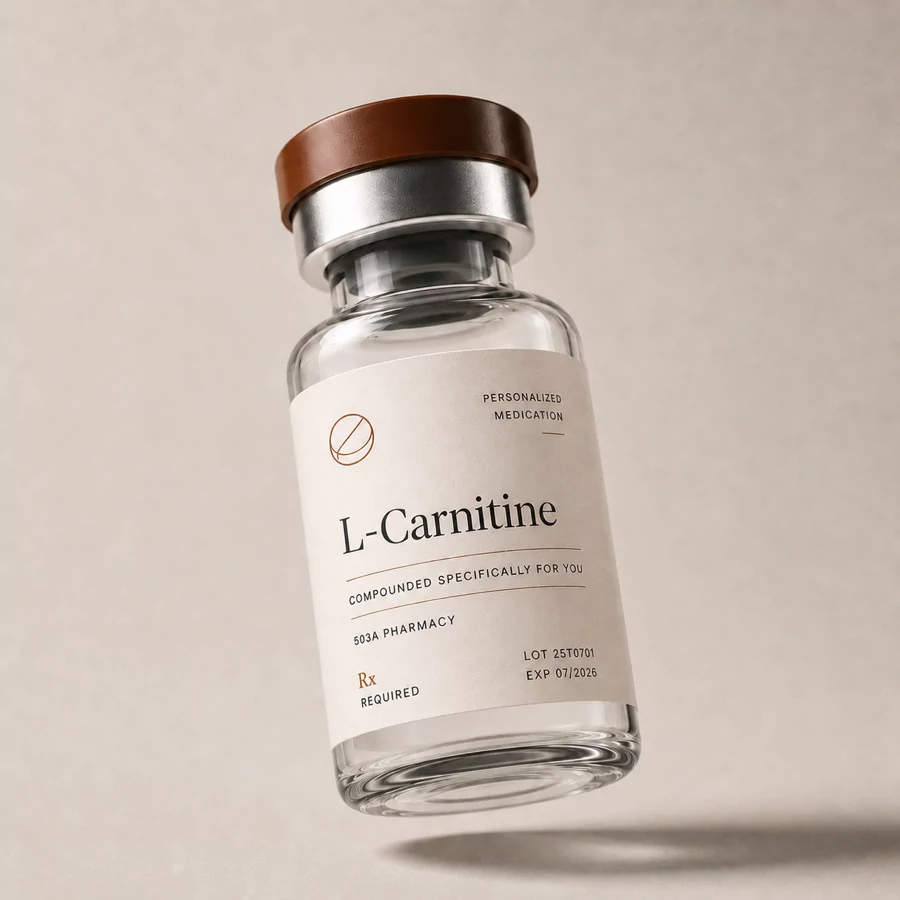
L-Carnitine 500 mg/mL
- $199.00 one time · L-Carnitine · 30 mL
Start your intake
A licensed clinician reviews your intake and decides whether treatment is appropriate.
Start your intakeAn L-Carnitine injection delivers a concentrated dose of this naturally occurring amino acid derivative directly into your muscle tissue. Your body synthesizes L-Carnitine primarily in the liver and kidneys from the essential amino acids lysine and methionine. In clinical and compounding contexts, L-Carnitine is provided as a sterile injectable solution at a concentration of 500 mg/mL. By utilizing an intramuscular route of administration, the compound bypasses the digestive system. This allows for direct absorption into the bloodstream, avoiding the first-pass metabolism that typically degrades oral supplements.
What L-Carnitine Is and How It Works
At a cellular level, L-Carnitine plays a critical role in energy metabolism. Your cells require energy to function, and a significant portion of this energy is derived from fatty acids. However, long-chain fatty acids cannot independently cross the inner mitochondrial membrane to reach the mitochondrial matrix, where cellular respiration occurs. L-Carnitine acts as the essential transport mechanism for this process.
When you receive an L-Carnitine injection, the compound enters your systemic circulation and is subsequently taken up by your cells, particularly in tissues with high energy demands such as skeletal and cardiac muscle. Inside the cell, L-Carnitine binds to long-chain fatty acids to form acylcarnitine. This molecule can safely traverse the inner mitochondrial membrane. Once inside the mitochondria, the fatty acid is released to undergo beta-oxidation, a metabolic process that breaks down fatty acids to generate adenosine triphosphate (ATP), the primary energy currency of the cell.
By facilitating the transport of fatty acids into the mitochondria, L-Carnitine supports the continuous production of cellular energy. It also assists in removing toxic byproducts of metabolism from the mitochondria, preventing the accumulation of short-chain and medium-chain fatty acids that can interfere with cellular function. The injectable format ensures that a measured, precise dose of this transport molecule is introduced directly into your system, maintaining higher systemic concentrations than oral delivery methods.
Who This Treatment Suits
L-Carnitine injections are considered for individuals who may require supplementary cellular support or those looking to optimize their body's natural metabolic processes. A licensed clinician reviews your intake and determines whether treatment is appropriate. You will undergo an evaluation of your medical history, current health status, and any ongoing medications to ensure compatibility.
This treatment is often evaluated for those who follow restrictive diets, such as strict vegans or vegetarians, since the primary dietary sources of L-Carnitine are red meat and dairy products. Individuals with specific metabolic profiles or those whose bodies may not efficiently synthesize adequate amounts of L-Carnitine from endogenous precursors might also consider this intervention.
You should approach this treatment with the understanding that L-Carnitine serves a specific physiological function. It is a transport molecule for fatty acids, not a direct stimulant. The suitability of this compound relies on your body's baseline levels and specific metabolic demands. It is not suitable for individuals with certain pre-existing conditions, including severe renal impairment, history of seizures, or specific thyroid disorders, unless explicitly cleared by a healthcare professional. Your clinical consultation will define whether the physiological mechanism of L-Carnitine aligns with your current health parameters.
What to Expect from Treatment
When you begin treatment with L-Carnitine injections, the process involves a routine intramuscular injection. You will administer the solution into a large muscle, typically the thigh or the gluteal muscle. The 500 mg/mL concentration requires precise measurement using the provided syringes. Upon injection, you may experience mild, localized discomfort at the injection site, which is typical for intramuscular administration and generally resolves quickly.
Because L-Carnitine operates on a cellular level to transport fatty acids, the physiological effects are not instantaneous. You will not feel a sudden surge of energy or immediate physical alteration. Instead, the compound integrates into your existing metabolic pathways over time. The absorption into your bloodstream occurs relatively quickly following the injection, but the subsequent cellular uptake and utilization of the compound require sustained consistency.
You must follow the specific protocols provided by your clinician. Side effects, while uncommon when administered correctly, can include localized swelling, mild nausea, or a metallic taste in the mouth. The compound is water-soluble, meaning your body will excrete any excess through urine. This underscores the necessity of adhering strictly to the prescribed dosing schedule rather than attempting to accelerate the process through higher doses. The clinical expectation is a steady, supported metabolic environment rather than acute, observable shifts in your daily function.
Dosing, Pricing, and Fulfilment
The L-Carnitine injection is provided in a 30 mL vial at a concentration of 500 mg/mL. The pricing is structured at $199.00 once for the L-Carnitine · 30 mL plan.
A licensed clinician reviews your intake and determines whether treatment is appropriate. If approved, your prescription is routed to a state-licensed compounding pharmacy. It is important to note that compounded medications are not FDA-approved. They are prepared by state-licensed compounding pharmacies under Section 503A of the Federal Food, Drug, and Cosmetic Act, ensuring they meet specific quality and safety standards for individual patients.
Fulfilment occurs entirely through discrete shipping. Once the pharmacy prepares your specific vial, it is shipped directly to your provided address alongside all necessary supplies, including syringes and alcohol prep pads. Available where our clinicians and partner pharmacies are licensed; eligibility is confirmed during intake. You will receive detailed instructions on how to safely self-administer the intramuscular injections. You can proceed to the secure checkout at https://joinbodygood.com/intake/l-carnitine.
Are compounded medications FDA-approved?
No. Compounded medications are not FDA-approved. They are prepared by state-licensed compounding pharmacies under Section 503A to meet the specific requirements of a clinician's prescription for an individual patient. The pharmacies utilize pharmaceutical-grade ingredients and adhere to strict regulatory standards, but the final compounded product does not undergo the FDA approval process.
How is the L-Carnitine injection administered?
L-Carnitine is administered via an intramuscular injection. This means the fluid is injected deep into a muscle, typically the thigh or glute. This route allows the compound to be absorbed directly into the bloodstream. You will receive sterile syringes, needles, and clear instructions on how to safely perform this injection at home.
How long does a 30 mL vial last?
The duration a 30 mL vial lasts depends entirely on the specific dosing schedule prescribed by your clinician. Because every patient receives a customized protocol based on their individual clinical review, you must follow the precise instructions provided with your medication.
Does L-Carnitine cause side effects?
Most individuals tolerate L-Carnitine injections well when following their prescribed protocol. However, some may experience localized reactions such as redness, swelling, or mild pain at the injection site. Less common systemic effects can include mild gastrointestinal discomfort or a slight metallic taste. If you experience persistent or severe side effects, you should contact your clinician immediately.