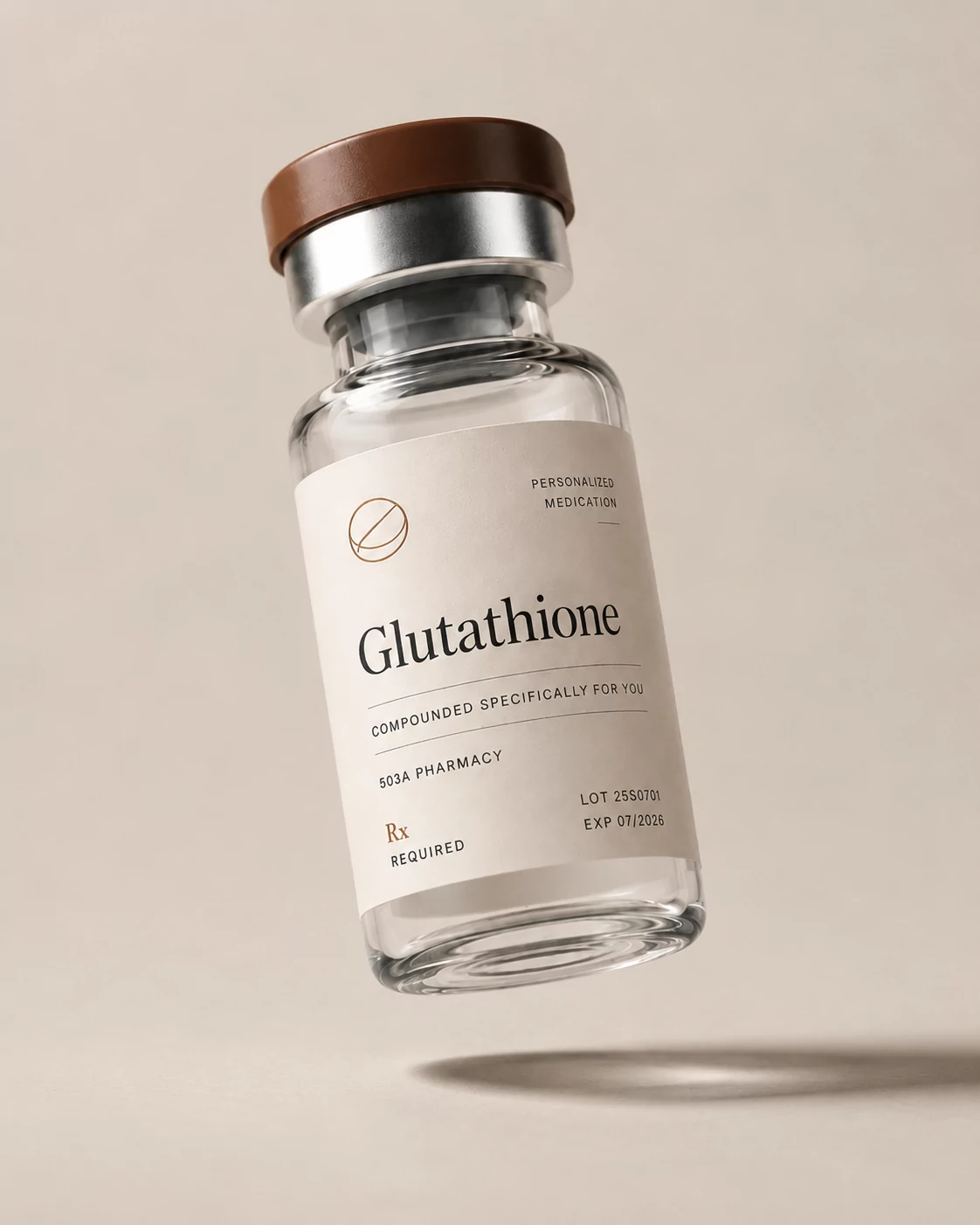
glutathione injection · 5 mL and 30 mL
- $99.00 one time · Glutathione · 5 mL
- $99.00 per month · monthly · 5 mL
- $199.00 one time · Glutathione · 30 mL
Start your intake
A licensed clinician reviews your intake and decides whether treatment is appropriate.
Start your intakeWhat It Is and How It Works
Glutathione is a peptide composed of three amino acids. These amino acids are glutamine, glycine, and cysteine. Your liver produces this compound naturally. It functions primarily as an antioxidant within your body. An antioxidant is a molecule that neutralizes free radicals. Free radicals are unstable molecules that form during normal cellular processes. They also form in response to environmental stressors. When free radicals accumulate in your cells, they cause oxidative stress. Oxidative stress can alter cellular structures like DNA, proteins, and cell membranes.
Glutathione plays a direct role in managing this oxidative stress. It binds to reactive oxygen species. This binding neutralizes them before they cause structural damage to the cell. In addition to neutralizing free radicals, glutathione is involved in tissue building and cellular repair. It acts as a cofactor for several antioxidant enzymes. It also plays a role in the regeneration of other antioxidants, such as vitamin C and vitamin E.
The body utilizes glutathione in various metabolic and biochemical reactions. It participates in DNA synthesis and repair. It is involved in protein synthesis. It helps synthesize prostaglandins. It is important for the transport of amino acids across cell membranes. It also plays a role in the activation and regulation of certain enzymes within the body.
A glutathione injection delivers this peptide directly into your muscle. This is known as an intramuscular administration. This method bypasses the digestive system completely. Oral glutathione supplements must pass through the gastrointestinal tract. In the gut, digestive enzymes break down proteins and peptides. This breakdown can reduce the amount of intact glutathione that ultimately reaches your bloodstream. An intramuscular injection avoids this first-pass metabolism. It introduces the compound directly into the systemic circulation.
The bioavailability of injected glutathione is generally higher than that of oral forms. Bioavailability refers to the proportion of a substance that enters the circulation when introduced into the body. By bypassing the digestive tract, the injected dose is completely available to your tissues. Once in the bloodstream, glutathione is transported to cells throughout your body.
Inside the cell, glutathione exists in two distinct forms. The reduced form is the active antioxidant. The oxidized form is the state it takes after it has neutralized a free radical. The ratio of reduced to oxidized glutathione is often used as a clinical marker of cellular toxicity. A healthy cell maintains a high ratio of the reduced form to manage daily cellular stress.
Who It Suits
Glutathione injections are considered by individuals looking to supplement their natural levels. Your body's production of glutathione can decrease for several reasons. Age is one common factor. The natural synthesis of this peptide slows down over time. Diet can also affect your baseline levels. A diet lacking in sulfur-rich amino acids may limit your body's production capacity. Environmental factors play a role as well. Exposure to certain chemicals or prolonged physical stress can deplete your stores faster than your body can replace them.
People who experience difficulty absorbing nutrients through their digestive tract might choose injections. Conditions affecting the stomach or intestines can impair the absorption of oral supplements. Injections provide an alternative route of administration for these individuals.
This treatment suits adults seeking to support their cellular antioxidant capacity. It is also an option for those who prefer the dosing schedule of an injection over taking daily oral capsules. A licensed clinician reviews your intake and determines whether treatment is appropriate. They will consider your medical history. They will evaluate your current medications. They will assess whether this specific compound aligns with your physiological needs.
You should inform the clinician of any known allergies. Tell them if you are pregnant or breastfeeding. Discuss any current medical conditions in detail. This information helps the clinician make an informed decision regarding your eligibility for this specific treatment.
What to Expect
When you receive a glutathione injection, the liquid is deposited deep into the muscle tissue. The most common injection sites are the thigh or the deltoid muscle in the upper arm. You may feel a slight pinch when the needle enters the skin. You might also experience a mild burning or pressure sensation as the fluid enters the muscle. This is typical for intramuscular injections.
After the injection, the area may be slightly red or tender to the touch. Some people experience minor swelling or a small bruise at the injection site. These local reactions are generally temporary. They often resolve on their own within a few days. You can apply a cold compress if you experience discomfort at the site.
You will not feel an immediate systemic change. Glutathione acts at a cellular level over time. It is a supportive compound, not a central nervous stimulant. You should not expect a sudden surge in energy or a rapid alteration in how you feel daily. The process of neutralizing oxidative stress and supporting cellular function is gradual.
Some individuals may experience mild side effects. These can include a low-grade fever or body aches. Some people report mild nausea or digestive upset following an injection. If you experience persistent or severe side effects, you should contact a medical professional immediately. A licensed clinician reviews your intake and determines whether treatment is appropriate, but monitoring your own body's response remains your daily responsibility.
Dosing and Fulfilment
The exact dosing schedule for glutathione injections depends on the specific protocol prescribed by the clinician. The medication is provided in either a 5 mL or a 30 mL vial. The concentration and volume dictate how many doses are contained in each vial. You will draw the prescribed amount into a syringe for each administration.
You will self-administer the injections at home. The package includes the medication vial, syringes, and alcohol prep pads. You must clean the injection site with an alcohol pad before each use. You must use a new, sterile syringe every time you administer a dose. Never reuse a needle. Proper disposal of used needles in a rigid sharps container is strictly required.
These are compounded medications. Compounded medications are not FDA-approved but are prepared by state-licensed compounding pharmacies under Section 503A. They are made to order based on a clinician's prescription for a specific patient.
Available where our clinicians and partner pharmacies are licensed; eligibility is confirmed during intake. Once approved, the pharmacy prepares your specific vial. The medication is then shipped directly to your provided address. Shipping is handled with care to maintain the integrity of the peptide during transit. You should store the vial according to the exact instructions provided with your package. Some compounded peptides require refrigeration, while others may be kept at room temperature away from direct light.
Pricing and Plans
Prices are set based on the volume of the medication. The available plans are:
- One time: Glutathione · 5 mL, $99.00 (2026)
- Monthly: monthly · 5 mL, $99.00 (2026)
- One time: Glutathione · 30 mL, $199.00 (2026)
To proceed, visit https://joinbodygood.com/intake/glutathione
How is glutathione administered?
It is administered as an intramuscular injection. You inject it into a muscle, typically the thigh or upper arm. This method bypasses the digestive system entirely, delivering the compound into the muscle tissue for absorption into the bloodstream.
Is this product FDA-approved?
No. Compounded medications are not FDA-approved but are prepared by state-licensed compounding pharmacies under Section 503A. The formulation is prepared specifically for you based on a clinician's prescription.
Do I need a prescription?
Yes. A licensed clinician reviews your intake and determines whether treatment is appropriate. You cannot purchase this medication without a valid prescription from a licensed medical professional.
Where is this treatment available?
Available where our clinicians and partner pharmacies are licensed; eligibility is confirmed during intake. We do not provide service in all regions, and specific availability is determined during the consultation process.
How should I store the vial?
Follow the specific storage instructions included with your shipment. Some formulations require refrigeration to maintain chemical stability. Always keep the medication out of reach of children and protect it from extreme temperatures or direct sunlight.
How long does a single vial last?
This depends entirely on your prescribed dose and frequency. A 5 mL vial contains less medication than a 30 mL vial. The clinician will instruct you on exactly how much to draw for each dose, which determines the overall duration of the supply.